










SMT machine capacity is often introduced through a rated CPH figure, but that number does not directly show how many finished boards a factory can produce per hour. Rated CPH describes placement performance under defined conditions. Actual output depends on the PCB, component mix, machine configuration, available operating time and the slowest process in the complete SMT line.
A practical capacity comparison follows this relationship:
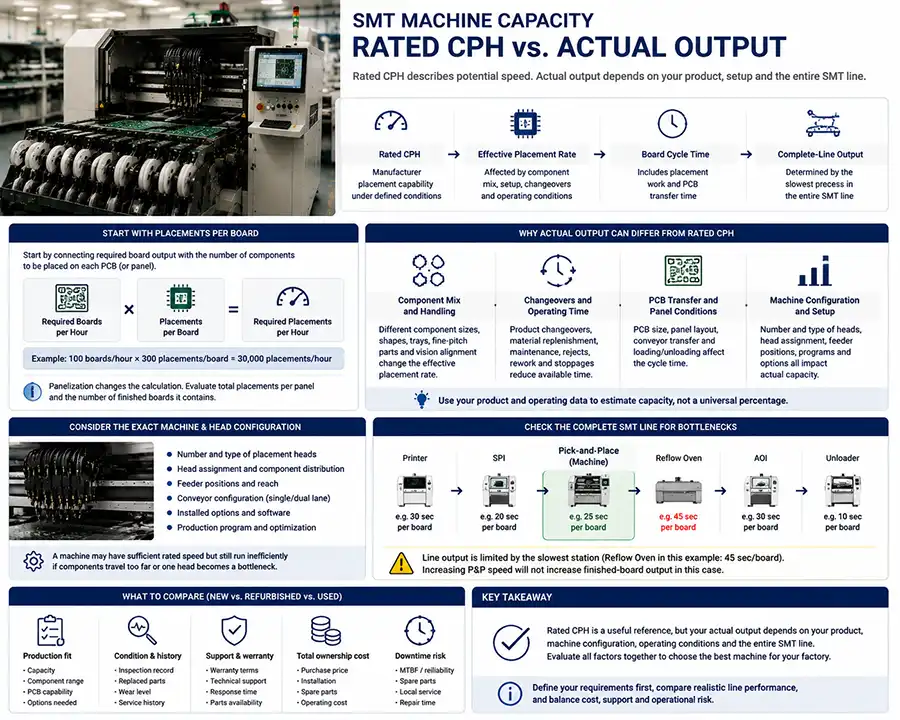
Rated CPH → Effective Placement Rate → Board Cycle Time → Complete-Line Output
Before comparing machine speeds, the factory should first choose an SMT pick-and-place machine for its production requirements. Once the required products, component range and PCB conditions are understood, CPH can be evaluated as one part of the broader equipment decision.
What Does Rated CPH Mean on an SMT Machine?
CPH generally refers to components or placements per hour. Manufacturers use the figure to describe how many placement operations a machine may complete under specified test or operating conditions.
Rated CPH is useful for comparing placement capability, but it is different from finished boards per hour, complete-line throughput and guaranteed factory output. Measurement methods, test components and operating conditions may also vary, so similar published figures do not necessarily produce identical results on the same factory product.
Effective placement rate describes the rate achieved with the actual component mix and operating conditions. Machine cycle time covers the work completed by the placement machine, while board cycle time also reflects PCB transfer and processing. Complete-line throughput is determined by the slowest required production step.
Start With Placements per Board
The first capacity calculation should connect the required board output with the number of components that must be placed on each PCB or production panel.
Required Boards per Hour × Placements per Board = Required Placements per Hour
For example, if a factory requires 100 boards per hour and each board contains 300 placements, the starting requirement is 30,000 placements per hour.
This is an initial workload calculation rather than a finished capacity result. Component handling, board transfer, changeovers, operating interruptions and the cycle times of other line stations must still be considered.
Panelization also changes the calculation. When several boards are processed in one panel, evaluate the total placements per panel, the number of finished boards it contains and the complete panel transfer cycle.
Why Actual SMT Output Can Differ From Rated CPH
The same placement count can produce different cycle times because products do not place every component under identical conditions.
Component Mix and Handling
A board containing many small, regularly supplied components may run differently from one containing large connectors, fine-pitch devices, tray-supplied parts or components requiring additional vision processing. Pickup method, movement distance, alignment requirements and handling time all influence the effective placement rate.
Changeovers and Available Operating Time
Product changeovers, material replenishment, operator intervention, maintenance, rejects, rework and unplanned stoppages reduce the time available for continuous placement. A stable high-volume product and a frequently changing high-mix schedule can therefore produce very different output from the same machine.
PCB Transfer and Panel Conditions
PCB size, panel layout, conveyor transfer, loading and unloading also affect the cycle. A placement machine may complete its assigned work quickly but still wait for the next board or for another production station to become available.
Capacity estimates should therefore use the factory’s product and operating data rather than applying one universal efficiency percentage.
Consider the Exact Machine and Head Configuration
Actual capacity depends on how placement work is distributed across the installed equipment configuration.
The number and type of placement heads, head assignment, feeder positions, component distribution, conveyor arrangement, installed options and production program can all affect the cycle. Where supported, single- or dual-lane operation may also change how boards and placement work move through the machine.
A machine may have sufficient total rated speed but still create an inefficient cycle if difficult components are concentrated on one head, feeder positions create excessive movement or the installed options do not match the product.
Evaluate capacity through the exact head, feeder, conveyor and software configuration rather than relying only on a model name or headline CPH figure.
Check the Complete SMT Line for Bottlenecks
The placement machine may not determine the final line output. The printer, inspection equipment, reflow process, board-loading system or unloading process may operate on a longer cycle.
Material availability and communication between stations can also create waiting time. In a line with multiple placement machines, uneven distribution of component work may cause one machine to limit throughput while another remains underused.
Complete-line throughput follows the slowest required production step.
Increasing placement-machine speed will not increase finished-board output when another station remains the bottleneck. Compare station cycle times and waiting conditions across the complete line before deciding that additional placement CPH is required.
Capacity Planning Inputs That Affect the Result
| Planning Input | Why It Matters |
|---|---|
| Boards required per hour | Defines the finished production target |
| Placements per board or panel | Converts board demand into placement demand |
| Component mix | Affects pickup, vision, handling and movement time |
| Panelization | Changes placements and finished boards completed per cycle |
| Changeover frequency | Reduces the operating time available for production |
| Machine configuration | Determines how placement work is distributed |
| Line bottleneck | May limit output below placement-machine capacity |
| Capacity margin | Supports production variability and future requirements |
These inputs must be considered together. High rated speed cannot compensate for an unsuitable component configuration, frequent changeovers or a slower upstream or downstream process.
Add Capacity Margin for Production Variability
Selecting capacity equal to the current minimum requirement may leave little room for demand peaks, new products, more complex components or temporary production losses.
A suitable margin may need to support future production growth, demand fluctuations, additional component types, changeovers, maintenance and increasing product complexity. The required margin should reflect factory records, future plans, production risk and the consequences of insufficient capacity.
Using one fixed percentage for every factory can either create unnecessary investment or leave the line without enough reserve. Capacity margin is most useful when it is connected to real operating variability and expected growth.
Estimate the Capacity Requirement Before Comparing Machines
A practical evaluation can follow this sequence:
Define the required boards per hour or boards per shift.
Count the placements required per PCB or production panel.
Calculate the starting placements-per-hour requirement.
Review the component mix and identify parts requiring additional handling or vision.
Check how the placement work would be distributed across the machine configuration.
Account for changeovers, replenishment, maintenance and expected downtime.
Compare cycle times across the complete SMT line.
Add a capacity margin based on production variability and future requirements.
Compare available machines using the resulting workload rather than rated CPH alone.
The central questions are whether the machine can support the required board output, whether its head and feeder configuration fits the component mix, and whether another production step will limit the final line cycle.
After completing this assessment, buyers can compare available ASM/SIPLACE SMT machines against the required workload, line arrangement and future production plan.
Compare SMT Machine Capacity With Your Production Target
Prepare the following information before requesting a capacity comparison:
Target boards per hour or per shift
Placements per board or panel
Main component types
Product mix
PCB dimensions and panel information
Shift duration
Expected changeover frequency
Existing line equipment
Future capacity requirement
Preferred machine series when known
Contact us through WhatsApp to compare these production inputs with available ASM/SIPLACE machine configurations.
Rated CPH alone is not enough to recommend a machine or establish achievable output. A useful comparison requires actual product information, the intended machine configuration, operating conditions and the capacity of the complete SMT line.
Frequently Asked Questions About SMT Machine Capacity
What does CPH mean on an SMT machine?
CPH generally refers to the number of component placements a machine can complete per hour under defined test or operating conditions.
Is rated CPH the same as actual production output?
No. Rated CPH describes specified placement performance, while actual output is shaped by the product, component mix, machine configuration, available operating time and complete-line bottlenecks.
How can I estimate boards per hour from SMT machine CPH?
Start by multiplying the required boards per hour by the placements per board. Then account for component handling, transfer time, changeovers, downtime and the cycle time of the complete line.
Why can two boards with the same placement count have different cycle times?
The boards may use different component sizes, feeder types, vision requirements, pickup tools or movement patterns. These conditions affect handling and placement time even when the total placement count is the same.
Does a higher CPH machine always provide better value?
Not necessarily. Value also depends on production fit, machine configuration, flexibility, line balance, utilization, support and total investment. Additional rated speed creates limited benefit when another process controls the final output.
Conclusion: Rated CPH is a useful machine-comparison metric, but it is not a production guarantee. Placements per board provide the starting requirement, while component mix, machine configuration, available operating time and complete-line bottlenecks determine the achievable result. Capacity margin should reflect real factory conditions and future plans, and available machines should be compared only after the complete production requirement has been evaluated.